Discover Our Work
We bring over 20 years of experience from more than 50 diverse projects. The following selection from the field of product development illustrates the breadth and depth of our expertise.
Additional projects from the fields of Automotive, Energy Systems, Facility Technology, Household Appliances, Medical Technology and more can be found further below.
Please understand that, for reasons of client confidentiality, not all details can be disclosed.
Power plant filter
Task
These filters are used to separate solids (e.g. rust particles) and liquids (e.g. water droplets) from the gas flow. We were asked to find the cause of vibrations within the gas pressure control and measuring system. After investigating the flow behavior using CFD, these could be traced back to the asymmetrical and highly turbulent outflow from the filter in combination with the remaining system piping.
Solution
By adapting the internal components (while retaining the original filter cartridges), it was possible to achieve a uniform filter outflow and increase the separation efficiency. The filter is now shorter, which reduces installation space, welding time and weight. Above all, the pressure loss has been halved, what leads to a (hydraulic) power saving of approx. 15,000 W (equivalent to 2.5 MWh per week in 24/7 operation).
Film drying
Task
Tetrachloroethylene (PER) is used in a “wetgate” scanner for film archiving purposes. PER has favorable optical properties, e.g. it fills scratches in the film and makes it appear almost flawless to the scanner. However, PER is potentially harmful to health. At present, the film leaves the device too wet and it drips outside of the suction chamber. The compressed air nozzles used for drying do not manage to blow PER off the film sufficiently. We were asked to develop an optimized plug'n'play nozzle design.
Solution
Our nozzles convert the available compressed air into kinetic energy much more efficiently. So efficiently that the inlet pressure can be reduced by approx. 20 %, with approx. doubled blow-out speed. The film is now wounded up drip-free. The illustration shows the velocity fields in the middle of the film by means of CFD. The compressed air enters the blocks from behind and leaves them via two slots at each the top and bottom.
Intake pipe
Task
We were asked to design an intake distribution pipe for the adaptation of a larger throttle. The aim is to de-throttle the intake for the purpose of increasing performance.
Solution
Our flow-optimised design can be used plug'n'play without restrictions as a functional prototype (or as small series production). Manufactured via 3D printing (MJFMulti Jet Fusion).
Radial fan
Task
We were asked to optimize a fan with forward curved blades (aka squirrel cage or sirocco fan). This type of fan is typically used for ventilation purposes due to its compactness and relatively low noise emission. Unfortunately, their (static) efficiency is typically low, even if well designed only around 60 % at the best efficiency point (BEP). Furthermore, they cannot be designed according to Euler's turbomachinery equations. The aim is to reduce the power consumption in order to achieve a better energy efficiency index (EEI) for the appliance. Acoustic improvement is also desirable. The volute casing must not be modified in order to avoid adjustments to the injection molds.
Solution
The investigation of the flow fields in the reference fan by means of CFD showed that the impeller is much too large for the given operating point. This is indicated by massive backflows around the tongue. Our design increases the (static) efficiency of the fan by approx. 50 %. This corresponds to a (hydraulic) power saving of 11 W. Applied to 1,000,000 units and 400 operating hours per year, this results in 4,400 MWh. This is equivalent to the typical energy consumption of 1,260 German households (Statista 2019). Due to the lower circumferential velocity, the virtually eliminated jet flow and the increased impeller tongue clearance, the operating noise of the device has been reduced by approx. 3 db.
Ultrasonic water meter
Task
The flow behavior of a water meter shall be investigated, since it issues too high measuring uncertainties in some operating points. This is supposed to be usable for a very large dynamic rangeMaximum to minimum flow ratio (240 in this case). The currently used sensors (transducer) are to be retained.
Solution
Our designed variant fulfils all requirements. The flow in the measuring area is much more even which leads to lower measuring uncertainties over the hole operating range. In addition, the pressure loss is approx. 30 % lower.
Dust trap
Task
The currently used dust trap filters iron oxide dust by means of a glass fibre filter mat. It is to be investigated whether this mat can be substituted by a "smart" flow guidance. Just the bottom insert is allowed to be changed.
Solution
Our design meets all requirements and does not need an additional filter mat. The standard test regarding the filtration rate has been passed. Compared to the reference, the pressure loss could be reduced by approx. 20 %.
Fluid mechanics laboratory
Task
Selection of measurement technology, project planning and construction supervision. The available space must be used optimally. Research and teaching shall be possible in the same way.
Solution
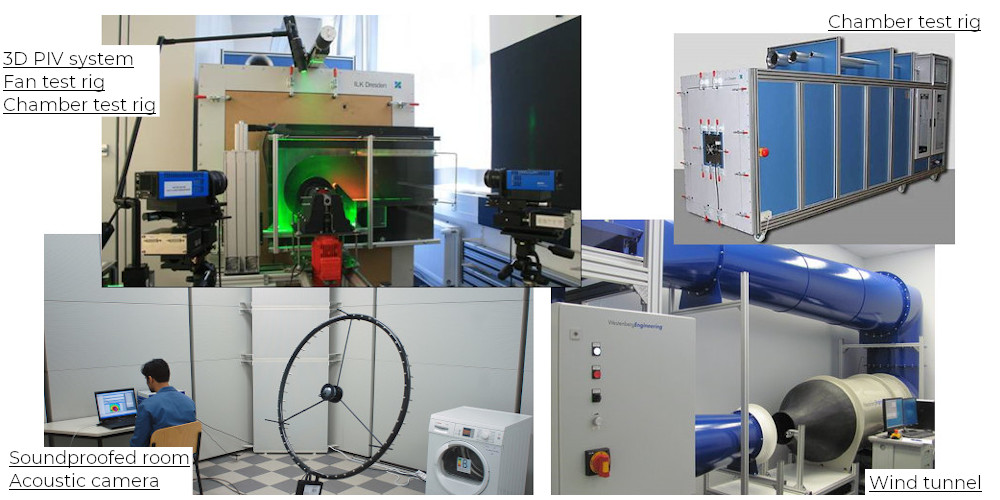
The laboratory is now (among other things) equipped with: soundproofed room, acoustic camera (beamforming), chamber test rig, 3D PIVParticle Image Velocimetry system, small wind tunnel. The floor planning also allows the combination of different test benches, e.g. chamber test rig and soundproofed room.
Room Air Pollution Reduction
Task
We were asked to concept a retrofittable polution reduction system for classrooms. The room air should be “exchanged” at least three times an hour without making it uncomfortable for people (e.g. through draughts). The use of High Efficiency-Particulate Airfilters (HEPA) and / or UVC disinfection and possible connection to a central ventilation system are assumed. The effectiveness of the system is to be demonstrated by means of CFD.
Solution
Our presented concept fulfils all requirements. It supports effectively the natural convection created by human waste heat. The air volume is filtered four times per hour, evenly across all tables. The maximum air velocity remains below 15 cm/s and is therefore not critical in terms of the German workplace directive ASR A 3.6. The distribution of particles, aerosols, bacteria etc. in the room is effectively reduced.
Heater
Task
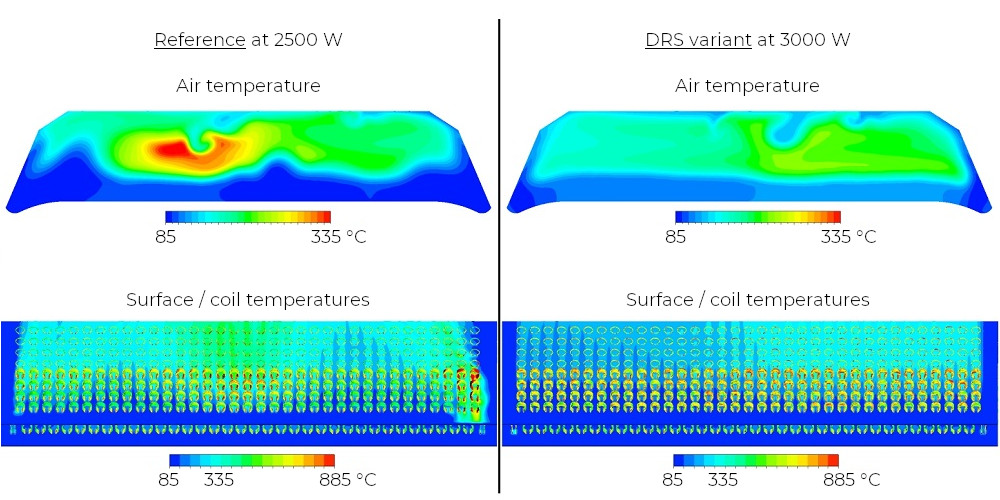
The existing heating system shall be optimised with regard to its heat distribution. The aim is to increase the heat output without increasing the fire hazard due to hot spots. Trials with different heating coil arrangements did not bring the desired success.
Solution
Due to the optimised inflow conditions, the heat power can easily be increased by 20 %. The temperature distribution is now much more even. At the same time, the maximum temperature at the outlet can be reduced by 100 °C.
Exhaust system
Task
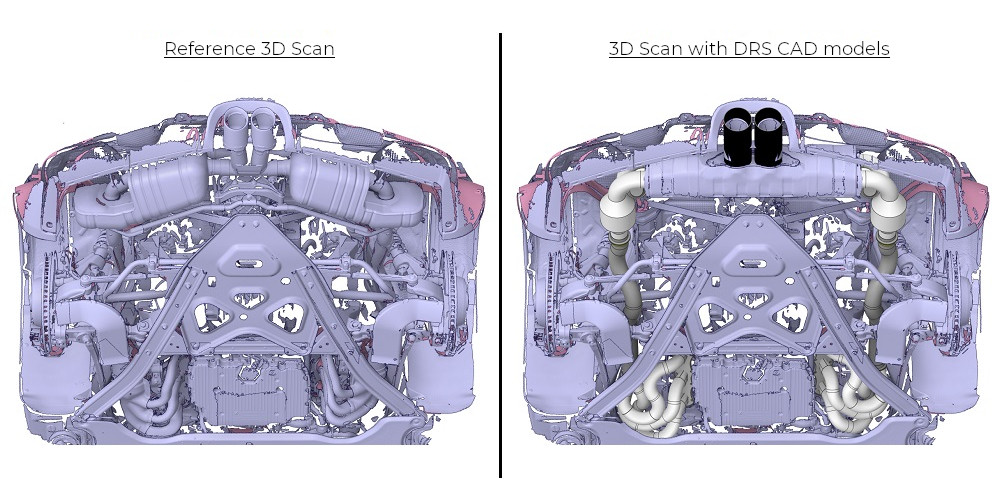
The exhaust system of a sports car is to be optimised for the purpose of increasing performance. Sufficient distance to heat-sensitive components (e.g. ignition coils) must be ensured. No parts may protrude from the underbody. In order to optimally use the available installation space while retaining the catalytic converters, we have digitally captured the underbody / engine with our 3D scanner.
Solution
Our design fulfils all requirements. The primary tubes are larger in diameter, equal long (their lengths differ only ± 2 mm or << 1 %) and designed symmetrically left / right. Due to identical (large) bending radii, the primary tubes can be produced efficiently using a CNC bending machine. The titanium muffler (from another model) features a X-pipe, which further improves the gas exchange.
Axial wheel meter
Task
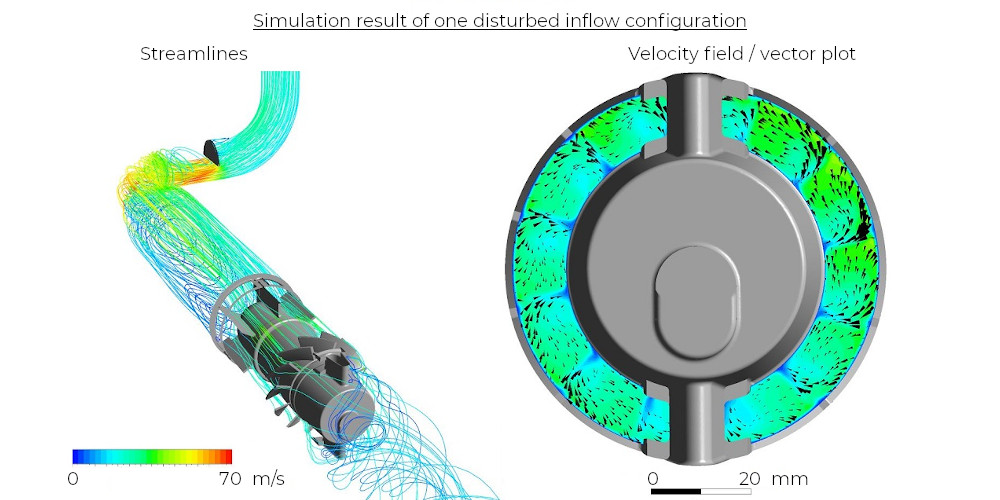
The existing axial wheel gas meter is to be investigated for its operating behaviour at different, disturbed inflows. Based on these findings, the rectifier element in front of the impeller shall be optimised.
Solution
Numerical simulations were used to identify the key areas. By making small changes to the rectifier, the operating behaviour is now constant over all (disturbed) inflow conditions.
Aerodynamics
Task
A sports car is to be equipped with plug-and-play aerodynamic add-ons. Rear wing and canards variants are assessed at different heights, angles of attack (AOA) and with / without Gurney flap. The objective: reduce lift or generate downforce while keeping drag increase as small as possible.
Solution
In the selected configuration, the baseline lift of about 600 N is converted into approximately 1200 N downforce. At the same time, the drag coefficient rises only slightly by ΔCd = 0.024. Calculations are based on a modified DrivAer model, shown results correspond to 250 km/h.
Intra okular lenses
Task
A test bench is to be developed for the in-vitro testing of the next generations of intraocular lenses. This will be used to stretch / compress / tilt the lenses and analyse the influence on the optical properties / refraction of light. The test bench shall be equipped with actuators and sensors to determine the force-displacement characteristics. The use of OCToptical coherence tomography must be made feasible. The investigation of real eyes should also be possible.
Solution
Our test bench fulfils all requirements and includes an additional preparation station. During the analysis and concept phase, several possible implementation approaches were identified. The most promising concept was produced in advance as a 1:1 model using 3D printing in order to be able to understand the handling and individual work steps. The final test bench was manufactured using high-precision CNC machines and uses eight force sensors and actuators.
Impeller optimization
Task
A turbomachine shall be optimized without changing the periphery. This also includes impeller diameter, width, shaft position and drive speed, leaving the blade profile as the only remaining parameter. CFD can be used to evaluate the velocity fields within the blade channels. Experimentally, e.g. using PIV, this is only possible at great expense.
Solution
The evaluation of the relative velocities, i.e. from a “co-moving Lagrangian view”, shows the separation and recirculation zones. A suitable blade profile from the NACA series is placed in these zones, here 35145-42. The static pressure build-up increases here by 8 % and the efficiency by 5 %. This is due to the significantly more uniform flow.
Electric motor
Task
We were asked to develop an interdisciplinary simulation workflow in Ansys Workbench for electrical machines. This was to include power electronics, electromagnetics, structural mechanics and fluid dynamics. The interactions and dependencies between the individual disciplines such as EM, FEA, CFD and CHT should be automatically analyzed and evaluated. This requires, among other things, a CAD scripting, which is shown here.
Solution
The Ansys Spaceclaim script, written in IronPython, contains 32 parameters. The permanently energized electric motor is rebuilt with every parameter change to ensure consistent data. In combination with design of experiments (DOE), nowadays you would call it AI, suitable motor configurations can be determined automatically and application-specifically based on the boundary conditions.
Gas meter
Task
A modular gas meter concept is to be developed. The concept shall be suitable for different markets, connection pipe distances and flow ranges. Subsequently, a functional prototype is to be created that can be tested in the climate chamber, among other things.
Solution
The functional prototype is divided into three segments. Using three different connection piece segments, six connection piece distances can be realized in U or S configuration. The middle module can be adapted to the desired measuring range using different sensing element configurations.
Lightweight magnesium wheels
Task
The driving dynamics of a sports car should be further enhanced by lightweight rims. These reduce the unsprung masses and improve the power-to-weight ratio. Compared to the already relatively light forged OEM aluminium rims, the weight of the set is to be reduced by 10 kg or almost 25 %. At the same time, however, the design idea is to be retained. The rims should also be suitable for motorsport activities, so that the weight saving potential beyond the 10 kg target should be translated into structural integrity. If possible, the rims should be fatigue-resistant even under double loads in accordance with ECE R124.
Solution
The rims are manufactured from forged AZ80 magnesium alloy blanks to achieve the weight reduction target. FEA detail optimisations lead to structural improvements. The first set of prototype rims delivered did not reach the target weight. We investigated the cause using our 3D scanner as quality check instrument. The scans showed that the supplier had deviated from the specification during CNC production. The image shows that the back of the spokes in particular were probably misaligned when switching from internal to external machining, which led to most of the excess weight.
Intercooler
Task
An optimized intercooler is to be designed for the purpose of boosting performance. It should fit plug'n'play into the existing installation space. Installation shall be possible using the OEM mounting options and connections.
Solution
By changing the throughflow, the pressure loss can be halved. As a result, performance can be increased without having to increase the turbocharger pressure. The response time improves and the so-called turbo lag is reduced.
Volute casing optimization
Task
A concept for optimizing volute casings of radial turbomachines is to be developed. The concept shall be adaptable to specifications regarding installation space as well as inlet and outlet flow constraints. The usability is to be proven by means of CFD simulations.
Solution
An iterative "sedimentation script" is created in Ansys CFX. The script leads to a geometry proposal after a few generations. In the example shown, the total pressure loss is lower by a factor of three, while the static pressure conversion is higher by a factor of 5.
Projects Overview by Industry
Vehicle and power unit electric drives
- Conception of multidisciplinary simulation workflow: CFD, FEM, EM, material design
- Script-based design rotor / stator / coils (32 parameters)
- Stress analysis rotor / stator (FEM, CFD, CHT)
- Parameter study DC DC converter (EM)
- Optimization DC DC converter cooler (CFD, CHT; Pcool + 20 %)
- Virtual tensile / bending test (FEM)
- Parameter study permanently energized reluctance machine (EM)
- Material model (SMC) validation through internal test series
- Testing and evaluation of internal and external technical solutions
- Advisory services for project manager and CTO
- Support with cost / schedule monitoring
Lightweight rims made of aluminium and magnesium alloy
- Conception and design (m – 4 kg with Al 6061, m - 10 kg with Mg AZ80 per set)
- Realisation of rim designs (f/r) under lightweight aspects
- Validation of structural integrity and fitment (FEM, vehicle measurements)
- Accompaniment of acceptance tests to obtain regulatory assessment certificates
- Cost / schedule planning
Lift kit, pneumatic front axle lift
- Conception and design (raising front axle by 30 mm)
- Implementation of AirCup design
- Selection of compressor, pipes, connectors, electrical components, etc.
- Electrical implementation
- Cost / schedule planning
High Performance exhaust system from titanium
- Conception (Ti CP Gr4, m - 8 kg, implementation of Helmholtz-Resonator)
- Design work based on own 3D scans
- Validation of the design (CFD, literature data)
- Cost / schedule planning
Intercooler (Charge-air cooler)
- Optimization / rearrangement of the radiator mesh (dp - 50 %)
- Supervision of design work
- Validation of the design (CFD, driving tests)
- Cost / schedule planning
Canards, rear wing and support
- Conception and design based on own 3D scans (cA - 180 kg)
- Design work based on own 3D scans
- Topology-optimised design of supports for 3D printing (SLM aluminium, m - 35 %)
- Validation of the design (CFD, FEM)
- Cost / schedule planning
Intake air ducts
- Conception and adaptation to existing air routing
- Design work based on own 3D scans
- Cost / schedule planning
Intake manifold
- Concept for adaptation of large throttle valve
- Design work based on installation space analysis
- Cost / schedule planning
Chassis for track operation
- Management of manufacturing components for tie rods / control arms
- Determination of camber, caster, toe, track width, wheel load parameters (driving tests)
- Cost / schedule planning
Tyre balancing machine
- Design of a mounting bracket
Mini G4 gas meter (ultrasonic / calorimetric, e.g. according to ISO 17089)
- Conception and design, including smart dust protection solution
- Conception for use of static and calorimetric sensors
- Ensuring function for accuracy class 1 (CFD, CHT, lab)
- Management of prototype build-up (internal / external)
- Management of laboratory activities (Q, dp measurements) including use of climate chamber
- Evaluation of internal and external technical solutions
- Supporting team development through technical evaluation of applicant engineers
- Advisory services for the R&D Manager
Modular G10-G40 gas meter (ultrasonic, e.g. according to ISO 17089)
- Conception and design of modular housing for different meter classes, country variants as well as for various types of gas (H2, G20, G25, G271, etc.)
- Conception and design of passive components for measuring range extension
- Ensuring function for accuracy class 1 (CFD, CHT, lab)
- Management of prototype build-up (internal / external)
- Management of laboratory activities (Q, dp measurements) including use of climate chamber
- Evaluation of internal and external technical solutions
Dust / liquid separators (GDRM stations, e.g. according to DVGW G 491)
- Optimization / rearrangement of internal structures (dp - 50 %, tweld - 10 %, m - 10 %)
- Validation of the design (CFD)
- Evaluation of external technical solutions
- Review of external expert opinion regarding resonances occurring in the existing product
Compact water meter (ultrasonic, e.g. according to OIML R49)
- Conception and design for vortex-free, homogeneous water flow
- Validation of the design (CFD)
- Management of laboratory activities (Q, dp measurements)
Cone valves 8-inch and 18-inch
- Calculation of flow and determination of impulse forces (CFD, VOF)
Dust protection for G4 gas meter
- Simulation of flow and particle distribution (CFD, FSI)
Water meter (DN150, turbine wheel)
- Simulation of disturbed inflow and its effect (CFD)
Hydropower plant
- Design work and tolerance calculations of / for assemblies
Test rig design (e.g. according to DIN EN 1319, DIN EN 60335, DIN EN IEC 60379, DIN EN IEC 63159)
- Conception of test benches for instantaneous water heaters, water storage tanks, pressure sensors
- Design of test rig for instantaneous water heaters and creation of the hydraulic plans
- Supervision of design of test rigs for water storage tanks, pressure sensors
- Creation of analytical tools for functional / operational (Q, dT, dp, q) as well as intake air / gas predictions for combustion of H2, G20, G25, G271, etc.
- Responsible for component selection, sensors, actors
- Cost reduction through alternative choice of equipment (approx. EUR 70k for two test benches)
- Testing and evaluation of internal and external technical solutions
- Advisory on solving errors in the test center (comparative and golden sample tests)
- Advisory services for team lead, side departments and standard committee
- Advisory on inflow / outflow conditions from evaporators / condensers in heat pumps
- Cost / schedule planning for instantaneous water heaters test rig
Heat pump heating system (e.g. according to DIN TS 12831, ISO 5149, VDI 6030)
- Management of the multicultural teams "Technical Survey" (TS) and "Technical Design" (TD), both professionally and disciplinarily, comprising a total of twelve people
- Implementation of Kanban-based, four-stage Technical Survey / Design Process (TS / TD)
- Specification of quality criteria and checklists for TS / TD
- Specification of standardized customer informations after TS / TD (90 % less queries)
- Implementation of interdisciplinary, needs-based personnel deployment "Everybody can do it"
- Implementation of supply chain simplification of radiators, one type instead of four when replacing
- Specification of installation requirements for under roof installations (additional EUR 400k revenue)
- Specification of installation requirements for one pipe heating systems (additional EUR 200k revenue)
- Creation of a tool for radiator power calculation according to standards
- Creation of a tool for automatic radiator type / size selection based on required heating power
- Creation of a tool for calculating usable water amount
- Conception of supply chain simplification for HK valves, one type instead of seven when replacing
- Conception of standardized installation, i.e. time- and space-saving arrangement / connection of all components (outdoor / indoor unit, water tank, pumps, etc.)
- Ensuring compliance with official requirements, e.g. correct hydraulic balancing
- Advisory services for the extended execution team
Room ventilation (retrofittable for classrooms / seminar rooms, e.g. according to ASR A3.6)
- Conception including fan, ventilation ducts, HEPA filter, UV-C disinfection
- Validation of the design (CFD)
- Cost / schedule planning
Industrial filter systems
- Design of sheet metal parts
Ventilation system for corrosive exhaust air
- Design of plastic parts / ducts
Refrigeration plants / chillers
- Design of parts&npbs;/assemblies
Laundry dryer (e.g. according to EN 60704, DIN EN 61121)
- Design / optimization of fans (ηstat + 100 %, Lp - 2 dB)
- Optimization of air flow for half load (Etot - 15 %, tTrocknung - 15 %)
- Validation of the design (CFD, lab)
- Parameter study wire coil heating (CFD, CHT, Labor; PHeiz + 20 %, Tmax - 100 K)
- Parameter study heat exchanger (CFD, CHT)
- Management of parameter study thermal insulation (lab)
- Management of design works
- Management of prototype build-up (internal)
- Management of laboratory services (Q, dp, n, M, P, dB measurements)
- Optimization of drying process (drying speed / energy consumption)
- Automatic tool for test evaluations (time requirement - 90 %, memory requirement - 99 %)
- Development of self-sufficient, self-regulating actuator for cooling air adjustment
- Cost reduction through common parts strategy
Cooker hoods (e.g. according to IEC 60335, DIN EN IEC 61591)
- Conception and design for small installation spaces and disturbed inflow / outflow (ηstat + 50 %, Lp - 3 dB)
- Design of impeller, scroll, housing
- Validation of the design (CFD, lab)
- Management of laboratory services (Q, dp, n, M, dB measurements)
Room humidifier (e.g. according to IEC 60335)
- Optimization fan and airflow guidings (ηstat + 20 %, Lp - 2 dB)
- Management of design works
- Validation of the design (CFD, lab)
Test rig intraocular lens (e.g. according to DIN EN ISO 13485, DIN EN ISO 11979)
- Conception for mechanical / optical measurements of accommodating intraocular lenses
- Design of modular test rig incl. sensors / actuators
- Management of external manufacturing
- Software adaptations (GUI)
- Management of software functionality extension
- Realisation of acceptance tests
- Cost / schedule planning
Positioning device for cutting / marking (e.g. in accordance with DIN EN ISO 13485, DIN EN ISO 11979)
- Conception of modular positioning device for intraocular lenses
- Design of parts and assembly
- Management of external manufacturing
- Commissioning of IR laser system (100 μJ) incl. implementation of acceptance tests
- Assessment of surface qualities (microscope, profile projector, white light interferometer)
- Realisation of acceptance tests
- Cost / schedule planning
Ventilator / respiratory device (e.g. according to DIN EN ISO 3744, DIN EN ISO 23372, DIN 45635, DIN EN 60601)
- Analysis of current pneumatic and electronic plans
- Modelling system behaviour (physical behaviour)
- Concept for real-time capable, modular 1D simulation
- Optimization air / O2 mixing chamber (CFD, dp - 30 %, improvement of O2 measurement)
- Management of design work
- Optimization of volume flow measurement by means of suitable sensors
- Creation of script for evaluation of operating and environmental data incl. noises
- Conception and design of exhaust system with floating body indicators
- Simulation ball drop test (FEM)
- Advisory services for product manager
Dental power tool (e.g. according to DIN EN ISO 7786)
- Development of test procedures for human-machine interaction (traffic light system)
- Creation, execution, evaluation of test sequences
- Execution and management of laboratory work (milling)
- Optimization of machining processes and extension of functional range / logging
- Release of firmware versions for further use in the CAM / manufacturing departments
- Implementation of "part loose" logic on the basis of existing measured values
- Support for start of production for assembly line
Steam sterilizer
- Determination of pressure loss, heat / velocity distribution (CFD, CHT)
- Optimization of rotary actuator for uniform mass flow distribution and small angles of rotation
- Reduction of cavitation risk by means of detail optimization
Disposables for laboratory equipment
- Execution of design work
- Conception of test plans and criteria
- Execution of prototype build-up
Film scanner rinse unit
- Wet scan through virtually bubble-free rinsing
- Validation of the design (CFD, VOF, lab)
- Execution design work
Film scanner drying unit
- Smart design enables higher drying capacity at lower inlet pressure (p - 20 %)
- Validation of the design (CFD, lab)
- Management design work
Test rigs for volume flow and drive power measurements (e.g. according to VDI 2044, ISO 5801, DIN 24163, DIN 45635)
- Selection of appropriate sensors / measurement equipment
- Management of needed services for hardware and software adaptions
- Creation of automated scripts for evaluation of operating and environmental data incl. noises
Electron microscope
- Vibration analysis of natural frequencies and harmonics (FEM)
- Advisory service regarding structura integrity
Waiting room
- Concept for local public transport
- Implementation of construction
Advice in general
- Solution strategy (cause <-> effect)
- Efficient execution of simulations / measurement campaigns
- Prototyping / Reverse Engineering
- Plausibility check / evaluation of numerical and experimental data
- Cost awareness / sustainability
- Concept for local public transport
- Implementation of construction
Advice in general
- Solution strategy (cause <-> effect)
- Efficient execution of simulations / measurement campaigns
- Prototyping / Reverse Engineering
- Plausibility check / evaluation of numerical and experimental data
- Cost awareness / sustainability
engineering office, CFD, computaional fluid dynamics, fluid mechanics, FEM, structural mechanics, simulation, topology optimisation, bionik, evolution strategy, CIP, Six Sigma, Lean Management, quality, innovation, efficiency, aerodynamic, air flow, fan, blower, pump